Quick comparison
The 60-second version. Both surfaces are durable, but only one degrades gracefully.
- Cost per sq ft installed: poured concrete $10–18 · pavers $18–35 (up to $35 for custom borders and full engineering)
- Lifespan: concrete 15–25 years before resurface or replace · pavers 30–50+ years
- Repair: concrete cracks require slab replacement or resurfacing · pavers lift and re-set in an afternoon
- Stain resistance: concrete stains permanently · individual pavers can be swapped out
- Utility trench (irrigation, gas, electrical): concrete requires demo and re-pour · pavers lift and reset over the trench
- Aesthetic: concrete reads builder-grade · pavers read as an architectural finish
- Resale: cracked concrete shows up in inspection reports · paver driveways read as an upgrade
- Best fit: concrete for garage floors and utility pads · pavers for driveways, patios, pool decks, and any luxury residential surface
The short answer
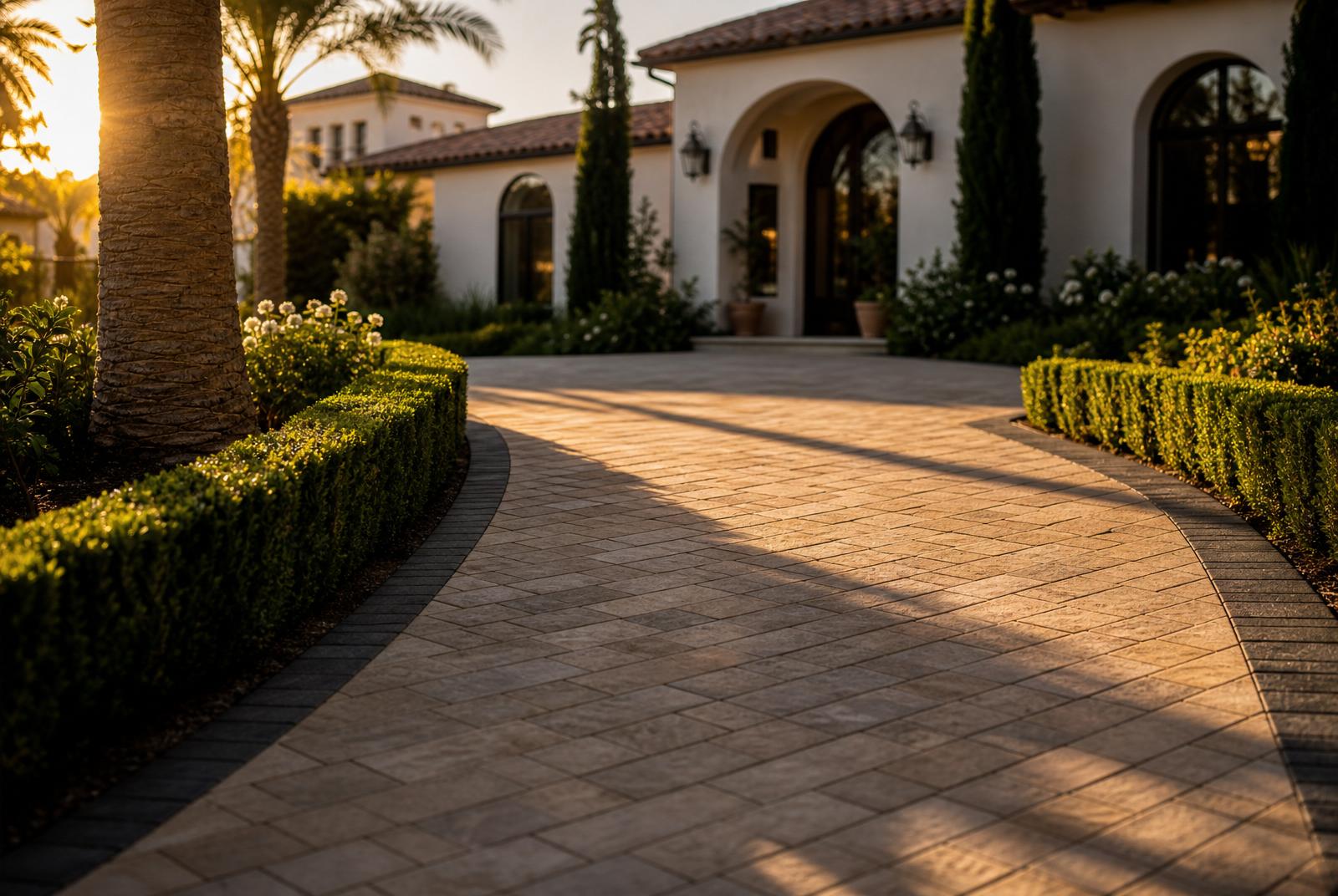
For any hardscape you want to still look luxury in 15 years, install pavers. For a utility surface — a garage-side pad, a garden shed footing — poured concrete is fine and cheaper. The mistake is choosing concrete for a front driveway, an outdoor living patio, or a pool deck because the up-front bid is lower. Concrete has failure modes that pavers structurally do not.
How each material actually fails
Concrete fails three ways: it cracks (thermal cycling, sub-base movement, tree roots), it stains (oil, irrigation, tannins), and it fades (UV bleaches the surface unevenly). None of these are repairable — they can only be resurfaced or replaced.
Segmental pavers effectively don't fail. Individual units can chip or stain, and they lift and re-set in an afternoon. The base and jointing beneath the pavers absorb the ground movement that would crack a slab.
- Cracks: concrete cracks in years, pavers don't crack at all
- Stains: concrete stains permanently, individual pavers can be replaced
- Utility trench: concrete requires demo and pour, pavers lift and re-set
- Settlement: concrete requires slab replacement, pavers can be re-leveled
- Fading: concrete fades unevenly, quality pavers are integrally colored
Cost, honestly
Poured concrete: $10-$18/sq ft. Stamped concrete: $18-$28/sq ft. Pavers: $28-$48/sq ft. Pavers are more up front. Over a 30-year ownership window, concrete gets replaced or resurfaced 1-3 times; pavers get lifted and re-set a fraction of the surface area. The costs cross well before year 15, and by year 25 pavers are substantially less expensive.
Resale and appraisal
In California's luxury market, appraisers and buyers both recognize pavers as an upgrade over concrete. Real estate agents in Beverly Hills, Newport Beach, and Montecito routinely cite paver driveways as a positive photo asset. Cracked concrete driveways are the opposite — they show up in inspection reports and shave offer prices.
When concrete still wins
Interior garage floors, non-visible utility pads, warehouse and commercial back-of-house, and temporary construction surfaces. There's nothing wrong with concrete as a material — it's just miscast as a luxury residential finish.
Frequently asked
Straight answers, no sales pitch.
Tap a question to see the full answer.
Continue reading