The all-in number for a paver driveway
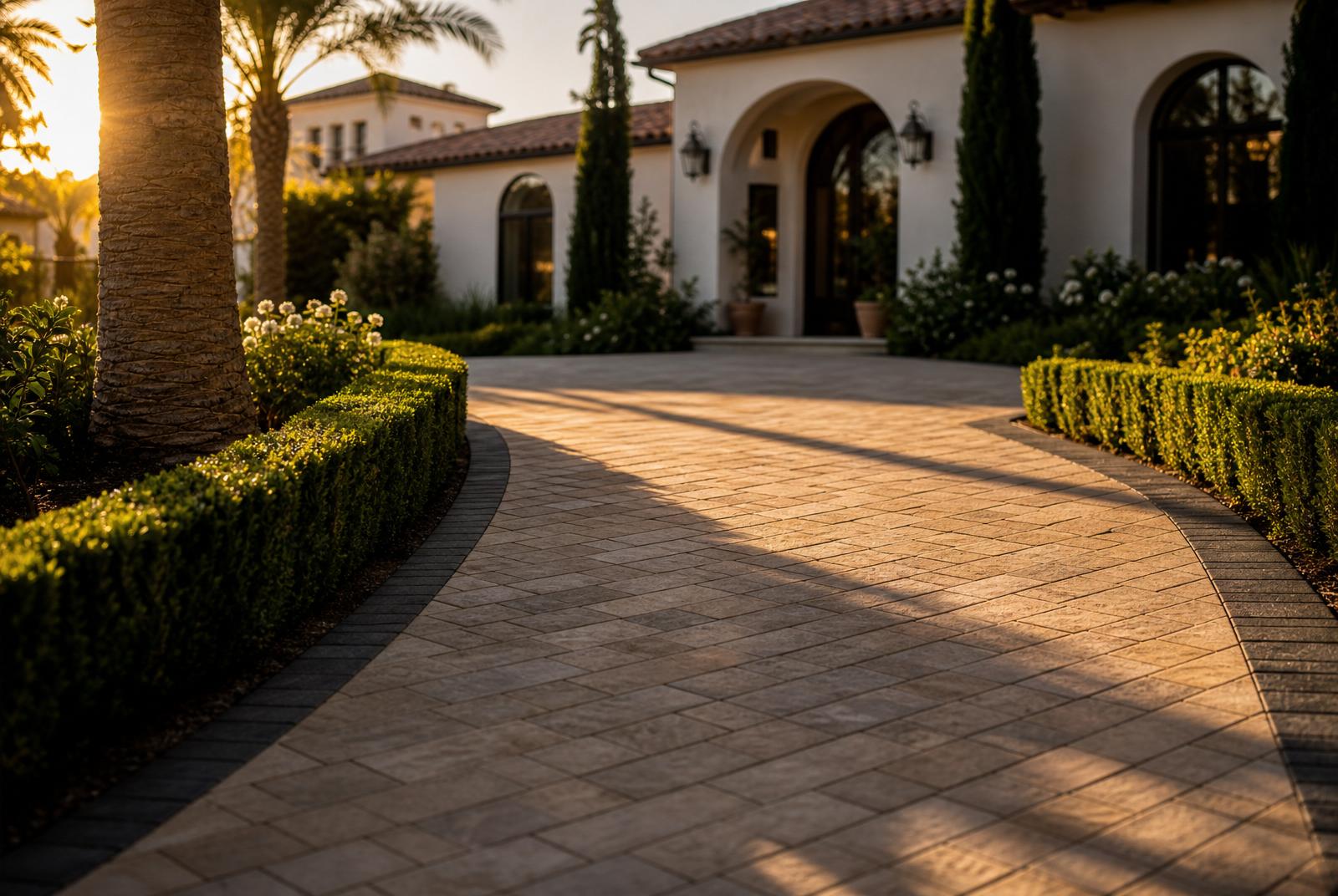
A quality paver driveway in Southern California priced honestly and fully installed runs $18-$35 per square foot in 2026. Most projects land in the low-to-mid $20s per square foot. That range covers demolition, haul-off, aggregate base, ASTM C33 bedding sand, the paver itself, polymeric joint sand, edge restraint, custom bordering, and a 25-year installation warranty. A 900 sq ft driveway lands between $16,000 and $32,000. Estimates below $18/sq ft almost always exclude demolition, disposal, adequate base depth, or a legitimate warranty — verify the scope before comparing.
What's included in a real installed price
A defensible per-square-foot number covers all of the following. If a competing bid is dramatically lower, ask which of these are missing:
- Demo of existing concrete or asphalt, plus haul-off fees
- Excavation to sub-base depth (6-10 inches)
- Geo-textile fabric where soils require it
- 6-8 inches of compacted Class II road base, installed in lifts
- 1 inch of ASTM C33 bedding sand, screeded flat
- The paver units themselves (Angelus, Belgard, Orco — concrete, interlocking, or unit pavers)
- Edge restraint at every unsupported perimeter
- Polymeric joint sand and joint stabilization
- Cut plans and custom borders
- Final compaction, cleaning, and walk-through
- 25-year installation warranty
What pushes cost up
Five factors move a driveway from the low end of the range to the high end:
- Material: standard concrete pavers → tumbled/textured interlocking → large-format unit pavers → coordinated flagstone accents
- Pattern complexity: running bond → herringbone → soldier-border with contrasting field → custom inlays
- Site conditions: flat suburban lot → moderate grade → hillside with drainage engineering
- Demo scope: gravel/dirt is cheap to remove; reinforced concrete is not
- Access: front-loaded driveway with truck access vs. hand-carried material
Concrete vs pavers on cost
Poured concrete typically runs $10-$18/sq ft installed in Southern California. Stamped concrete runs $18-$28/sq ft. Pavers cost more up front — usually 30-60% more than stamped concrete — but they don't fail in the ways concrete fails: no cracking across the slab, no fading, no full replacement when a utility trench is needed. Over a 30-year ownership window, the cost curves cross well before year 15.
Financing
We offer 0% financing through GreenSky and Synchrony on qualifying projects. Standard payment structure is a deposit at contract, a base-and-materials draw at start of production, and final payment at completion. We do not require full payment up front — any contractor who does is a red flag.
Frequently asked
Straight answers, no sales pitch.
Tap a question to see the full answer.
Continue reading