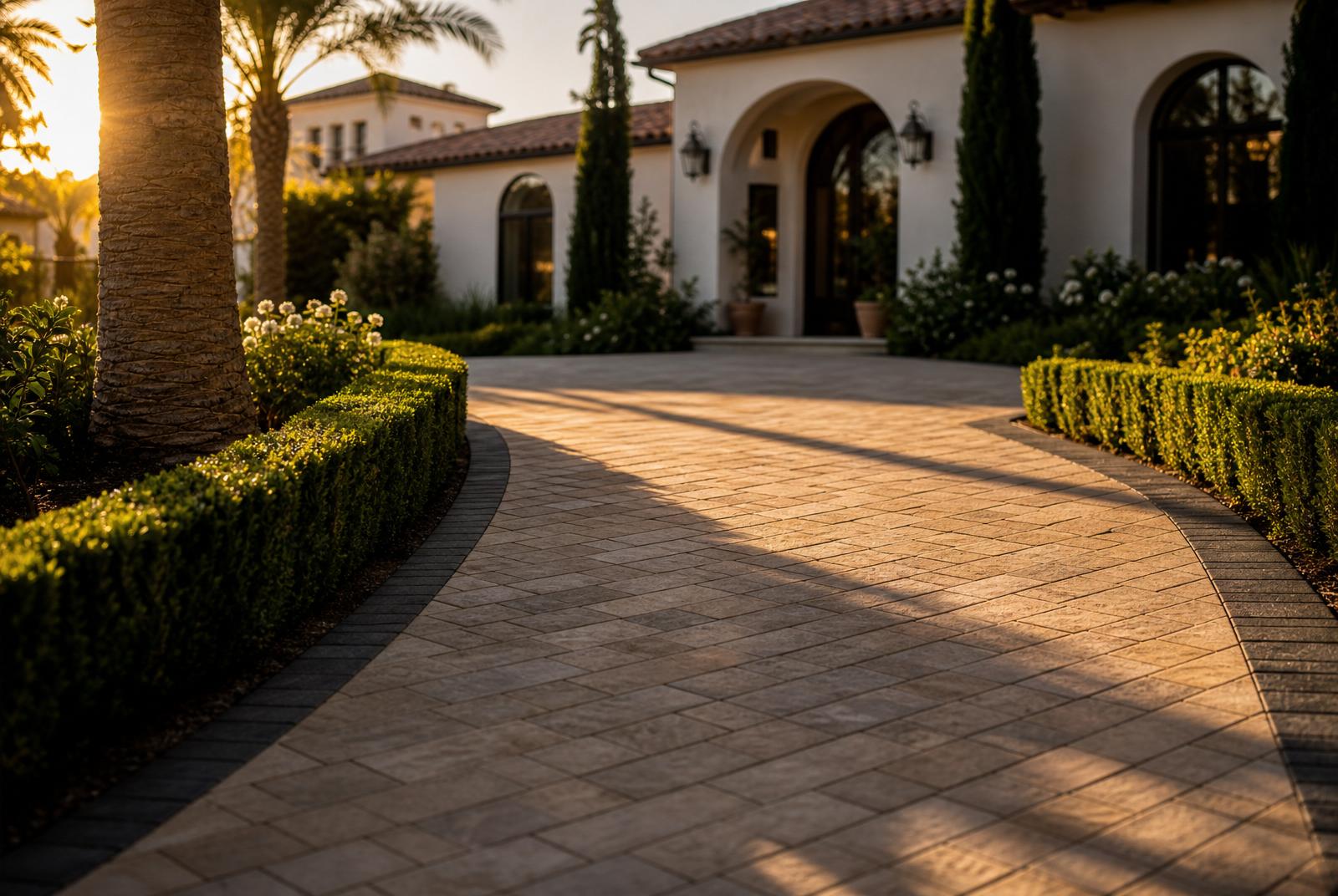
The four permeable paver systems
Every permeable hardscape you'll see on a California residential property is one of four assemblies. They share the same open-graded base logic but read very differently at the surface, and each fits a different use case.
- PICP (permeable interlocking concrete pavers) — Standard-looking concrete pavers with cast spacers that force a 3/8–1/2 in joint filled with clean #8 stone. The workhorse system for driveways and motor courts.
- Open-jointed unit pavers — Large-format concrete or unit pavers set with a wider 1/2–1 in joint, filled with decorative stone or fines. Reads architectural on modern patios and courtyards.
- Grid systems (gravel or turf) — A cellular plastic or concrete grid that stabilizes gravel or turf under vehicle load. Best for overflow parking, side yards, and ribbon drives.
- Planted-joint pavers — Large-format pavers set with a 1–2 in open joint planted with dymondia, creeping thyme, or micro-clover. Reads modern-Mediterranean and drains rainwater into the ground.
How to match the system to the use
The wrong system in the wrong place is the most common permeable-hardscape mistake. Driveways need load-rated PICP or a compacted grid system; patios and pool decks can use open-jointed or planted-joint assemblies for a softer read. Grid systems don't belong on primary patios where furniture sits, and planted joints don't belong under daily vehicle traffic — the plants get crushed. Match the assembly to how the surface is actually used.
What every permeable system shares
Whichever surface you choose, the base is the same: an open-graded aggregate reservoir 6–12+ in deep, a #57 choker course above it, and a clean #8 bedding stone under the pavers. That reservoir is what stores a design storm and lets water infiltrate the sub-grade over the following hours. Skip the reservoir and you have a decorative surface, not a permeable system.
Cost, rebates, and payback
A permeable system typically runs $3–$8 per square foot more than the same paver installed conventionally, driven by the deeper base excavation, the open-graded stone, and the joint detail. In most Southern California jurisdictions — MWD SoCal WaterSmart, LADWP, Santa Monica, Pasadena, Long Beach, San Diego — rebates of $2–$5+ per square foot offset most or all of that premium. On a 600 sq ft driveway that's $1,200–$3,000 back at close-out.
Aesthetic decisions that matter
Permeable joints are wider than standard joints. Detailed with clean, uniform joint stone in a color that coordinates with the paver, this reads intentional. Detailed with mismatched or dirty stone, it reads industrial. On planted-joint systems, the plant choice is the design — dymondia and micro-clover stay tight; creeping thyme and lippia bloom seasonally. Pick with the yard's palette in mind, not just the drainage math.
Where permeable systems don't belong
A permeable surface directly against a foundation, over expansive clay with high shrink-swell, or above an unstable hillside slope is a liability, not a feature. In those conditions we build a captured system — the surface still reads permeable, but a lined reservoir and perforated underdrain route water to storm drain instead of infiltrating. Our designer flags this at the site visit; homeowners should not guess.
Frequently asked
Straight answers, no sales pitch.
Tap a question to see the full answer.
Continue reading