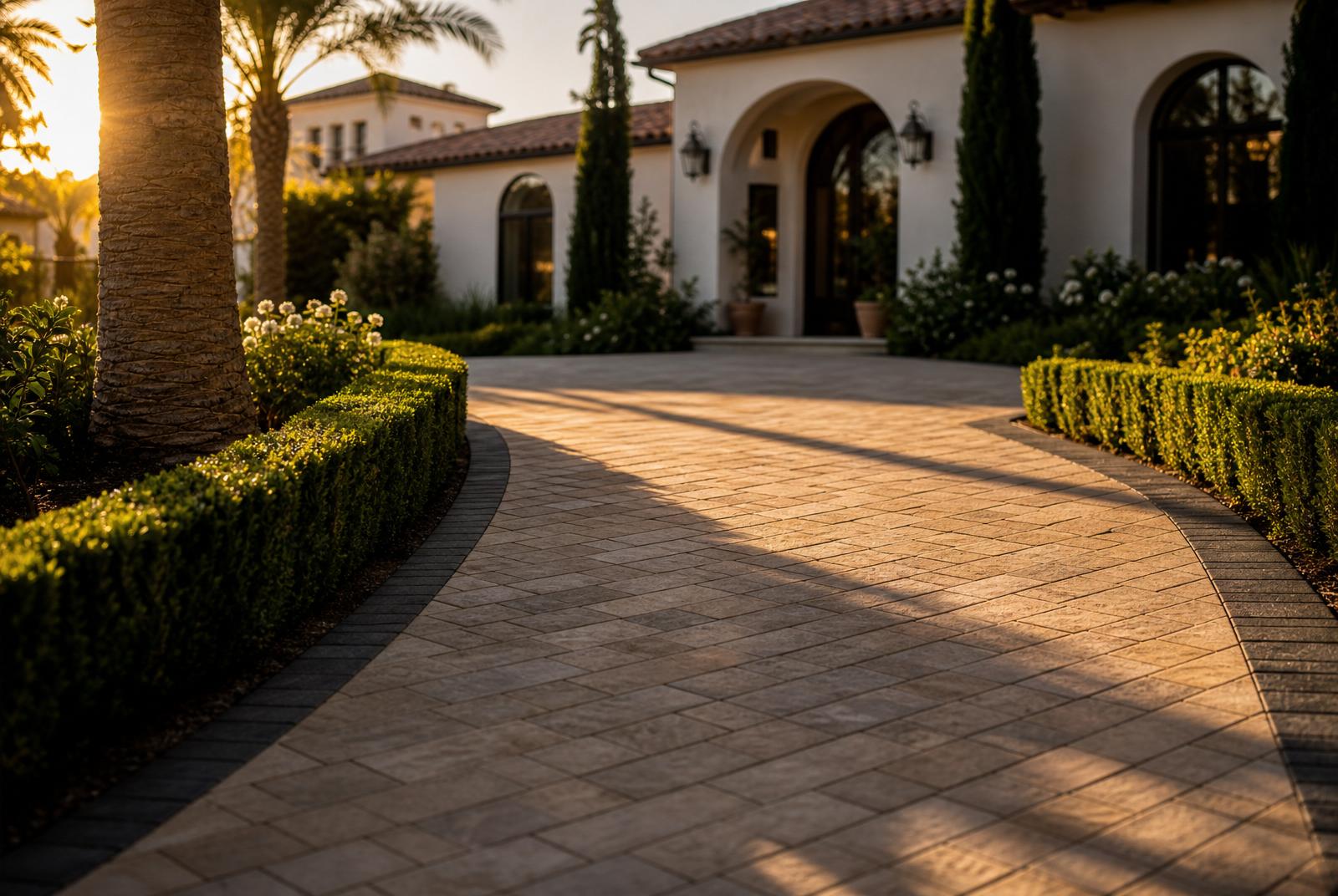
What a permeable paver system actually is
A permeable interlocking concrete paver (PICP) system replaces the impervious surface of a driveway or patio with a hardscape that behaves hydraulically like a gravel bed. Water enters through wider, open-graded stone joints, drops through an open-graded aggregate base, and either infiltrates into the native sub-grade or is collected by a perforated underdrain and released slowly.
The pavers themselves are typically standard concrete pavers — the intelligence is in the joints, the base, and the sub-grade decision.
The base cross-section, top to bottom
A correctly built permeable assembly has five distinct layers. Every one of them is load-bearing and hydraulically active — skip a lift, use the wrong stone gradation, or compact the sub-grade at the wrong moisture and the whole system fails.
- Layer 1 — Pavers: 60–80 mm concrete pavers with chamfered edges and cast joint spacers that force a 3/8–1/2 in open joint.
- Layer 2 — Joint & bedding stone: Clean, open-graded #8 stone (roughly 1/8–3/8 in) swept into joints and screeded 2 in thick beneath the pavers.
- Layer 3 — Choker course: 3–4 in of #57 stone (roughly 1/4–3/4 in) that locks the bedding stone and prevents migration into the reservoir.
- Layer 4 — Reservoir base: 6–12+ in of #2 or #3 open-graded aggregate (roughly 1–2.5 in) — this is the storage volume that holds a design storm.
- Layer 5 — Sub-grade: Scarified and lightly compacted native soil, or a geotextile-wrapped underdrain when infiltration is not feasible.
Sub-grade: infiltrate, exfiltrate, or capture
Three sub-grade strategies exist and picking the wrong one is the single most common permeable-system failure in Southern California.
Full infiltration works on sandy, well-draining sub-grade with a design infiltration rate of 0.5 in/hr or better. Most of coastal Ventura, coastal Orange County, and sandy Westside parcels qualify.
Partial infiltration adds a perforated underdrain near the top of the reservoir base, so heavy storms overflow to storm drain while smaller events still recharge groundwater. This is the default on most clay-heavy inland lots.
No infiltration — a fully lined, captured system — is required immediately adjacent to foundations, on expansive clay with high shrink-swell potential, or on hillside lots where infiltrated water could destabilize a slope. The paver reads permeable at the surface but functions as a detention tank.
Groundwater recharge and stormwater credit
Southern California imports the majority of its municipal water and — during storms — sends most of its rainfall directly to the ocean through storm drains. A permeable paver driveway inverts both problems on one parcel.
A typical 1,000 sq ft permeable driveway, on a full-infiltration sub-grade, recharges roughly 15,000–25,000 gallons of stormwater per year in a normal Los Angeles rain year — water that would otherwise be lost as runoff. Many jurisdictions credit permeable hardscape against required stormwater retention volume, unlocking rebates and, on new construction, easier LID (Low Impact Development) approval.
Where permeable pavers belong on a Southern California property
Not every hardscape wants to be permeable. Match the assembly to the use case.
- Driveways — the highest-impact application; a permeable driveway typically returns the largest rebate and the largest runoff reduction.
- Motor courts and long approaches — large footprints multiply infiltration credit and reduce standing water in winter storms.
- Patios on well-drained sub-grade — permeable patios eliminate the need for surface drains and slope-to-drain.
- Pool decks — only with a captured or partial-infiltration design; chlorinated water should not infiltrate directly to sub-grade.
- Immediately adjacent to a foundation — never full-infiltration; use a captured system or set the paver back with a waterproof band.
Maintenance — the part everyone skips
Permeable systems are the only paver assemblies with real maintenance. Joint stone slowly loads with organic fines and, over 5–15 years, infiltration rates drop.
Restoration is straightforward: a regenerative-air street sweeper or a strong wet-vac lifts the top inch of joint stone, the old stone is discarded, and clean #8 is swept back in. A single service every 3–5 years, plus a leaf-blow of the surface every fall, keeps a permeable driveway performing at design rate for its full 30–50 year lifespan.
How Paver Exchange engineers permeable in California
Every permeable project we install starts with a percolation test at the actual pavement footprint, a sub-grade classification, and a design storm calculation for the parcel. The base cross-section is drawn to the sub-grade result — not to a generic detail. Every submittal we prepare includes the LID or stormwater documentation the jurisdiction requires, and every rebate-eligible install ships with the paperwork the water agency asks for.
Frequently asked
Straight answers, no sales pitch.
Tap a question to see the full answer.
Continue reading